
Montera · Cockpit

Every desk.
One screen.

MOS is the operating system a design-and-build firm actually runs on. Enquiry to signature. Signed to handover. Hazri to payroll. All of it on one instrument panel that refreshes itself every five minutes.

Open the cockpit

What it is

MOS was not bought. It was built on the floor.

It started because the work was scattered. A pipeline in one tool, site updates in a group chat, materials in somebody’s head, and a weekly meeting to reassemble the picture badly.

So the firm built its own. Every desk got a screen that shows only that desk’s work, and above them all sits a cockpit that shows the whole business as gauges: speed, load, temperature, what is on fire. It is used every day by the people it was built for, which is the only real test software passes.

MOS is that system, packaged for other firms that run the same shape of work.

The service

A cockpit, not a CRM.

A CRM stores what happened. MOS runs what happens next. It is delivered as a hosted service with the four rails already wired. You bring your sites, your people and your bill of quantities, and the panel lights up.

The four MOS operating rails: Grow, Deliver, People and Money, and Command.
The four rails · enquiry to signature, signed to handover, hazri to payroll
See how a lead becomes a signature →

The modules

01

Cockpit

The whole firm as an instrument cluster.

Six gauges and a bank of warning lights. Messages in per hour. Men on ground. Enquiries today against a target of five a day. Things on fire. Sites reported. When a clock goes red it does not wait to be found. It lights up on the panel.
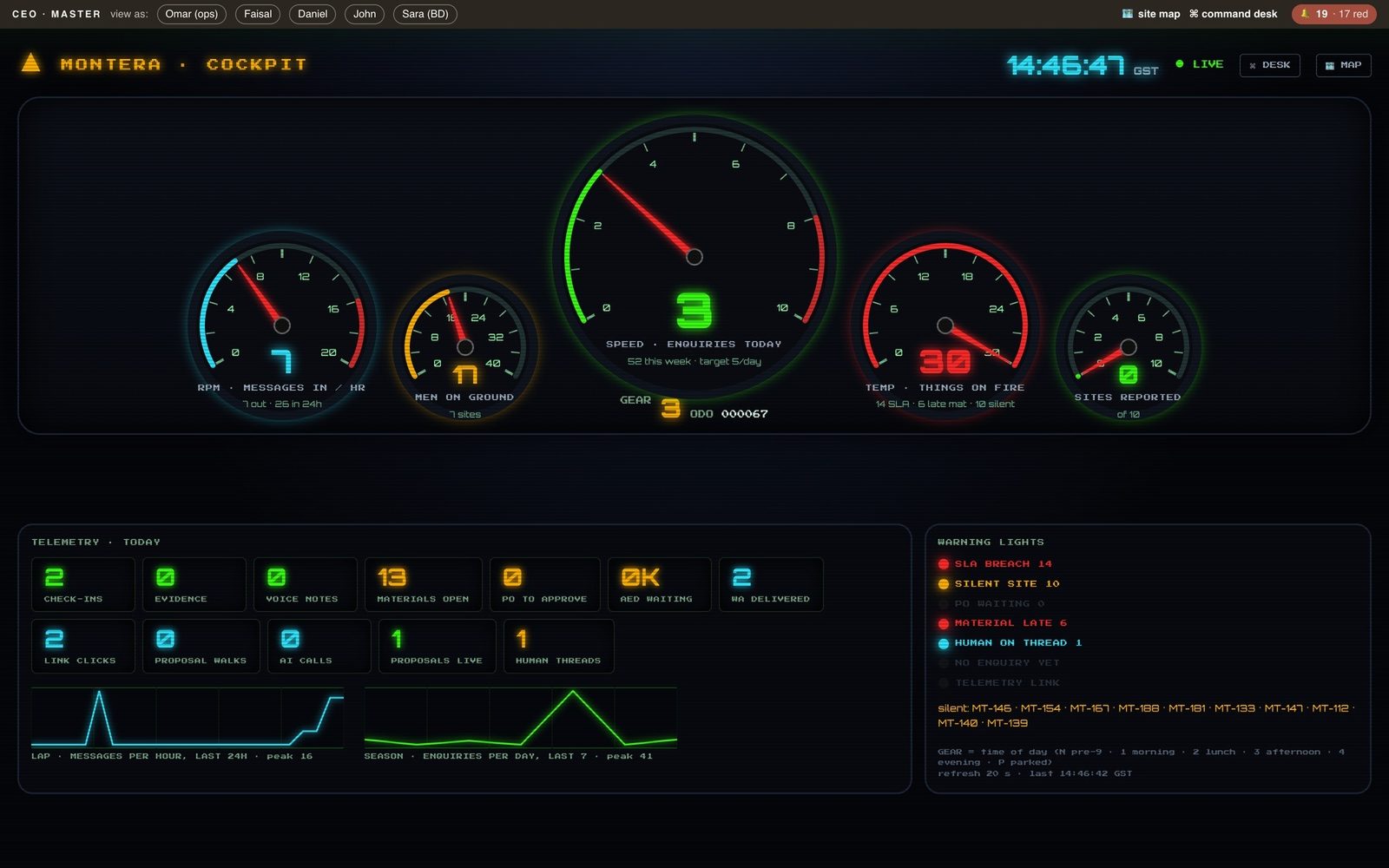
The MOS cockpit screen: five analogue gauges reading messages in per hour, men on ground, enquiries today, things on fire and sites reported, above a telemetry panel and a warning-lights list.
Cockpit · live gauges and warning lights
02

Command Deck

Every desk, one screen. Auto-refresh five minutes.

Four rails carry the business end to end. Grow runs enquiry to signature. Deliver runs signed to handover. People & Money runs hazri to papers to payroll. Command sees everything. Nobody has to remember where a thing lives.

The four MOS operating rails: Grow, Deliver, People and Money, and Command, each a chain of linked desks.
Command Deck · the four operating rails
03

Funnel

A phoned-in enquiry becomes a booked visit.

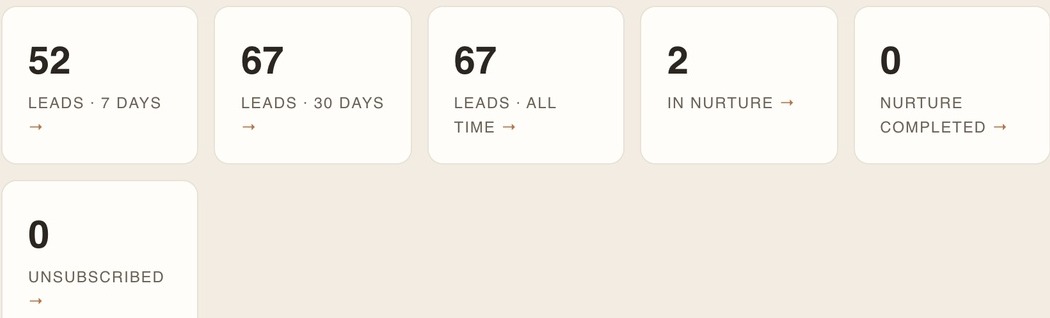
Capture is a phone number. Booking needs a slot, a community and a villa address, because the forty-eight-hour on-site promise needs a gate. Hand it to the AI and it carries the thread: qualify, book, brief the design call, quote, all of it visible on the Floor and on the project page.

MOS funnel counters showing leads over seven days, thirty days and all time, plus nurture and unsubscribed totals.
Funnel · aggregate lead counters
04

The Floor

One row per client. Red clocks first.

Qualify, Book, Visit, Design, BOQ, Present, Decide. Every client sits in exactly one stage with a clock running on it, and the list sorts itself so the overdue ones are at the top. There is a breach-free streak counter, and it is honest about being at zero.

MOS Floor stage filters (All, Qualify, Book, Visit, Design, BOQ, Present, Decide) beside a red-clock counter and a breach-free streak.
The Floor · pipeline stages and breach counter
05

Noor's Desk

Every conversation, and who has the wheel.

The last word said, on every open thread, most recent first, refreshing every three minutes. Full transcript one click down. From the same row you can leave a note, set a category, or book the visit, without opening another tab.

06

Proposals

BOQ to published quote, with the clock attached.

Priced packages off the bill of quantities, lines fixed, previewed, then published with tracked links and forty-eight-hour codes. You know it was opened. The twenty-one-day decision window runs on the Floor where everyone can see it.

Live snapshot · 07 Sept, 14:46 GST

It shows you the red first.

These are real readings off a running panel, not a marketing mock-up. Fourteen red clocks and twelve overdue tasks are on that list because the system is designed to put them where you cannot look away.

52
leads · 7 days
8
programmes live
10
sites live
14
red clocks
12
overdue tasks
5
min refresh cycle

Operating doctrine

Buy back the hour, then instrument it.

MOS is built on the buyback principle, the argument set out by Dan Martell in Buy Back Your Time, that an owner should buy back their lowest-value hours instead of selling more of them.

The part most firms skip is that you cannot buy back an hour you have never measured. So MOS instruments the hours first. It shows where the day actually goes: chasing a quote, re-asking a site for a photo, reassembling a picture that should have assembled itself. Only then does it hand those hours off. Noor qualifies and books. The design call gets briefed automatically. The deck refreshes without being asked.

What is left on the owner’s desk is the decision. That is the whole design goal.

Cited as a published methodology. Not an endorsement, affiliation or partnership.

Put the whole firm on one panel.

MOS is opening to a small number of design-and-build firms. Tell us how your work runs today and we will show you the cockpit against your own shape of business.

Request access
